
I wrote this article a little over two and a half years ago after working “Food Service” at the National Fallen Firefighters Foundation Memorial Weekend (NFFFMW) in 2022. I have since performed the same services at the 2023 and 2024 Memorial Weekends. What finally inspired me to publish the analysis of those special events, was when Retired FDNY Deputy Chief Frank Leeb described NFFFMW Food Service as “The Epitome Of Servant Leadership” at the May 2024 Eastern Division of the International Association Of Fire Chiefs Conference. Chief Leeb validated my perspective of a special character and attitude shared by our group providing what may be considered by others as a mundane responsibility. This article is about what humble leaders accomplish when they demonstrate the true traits of great leaders. This is my homage to this amazing and loving tribe that created the compassionate, and talented culture of service above self.
Leadership Lessons from Food Service at the 2022 National Fallen Firefighters Memorial
For the past 14 out of 16 years, I’ve had the honor of serving at the National Fallen Firefighters Memorial Weekend (NFFFMW) events. After nearly 46 years in the fire service, this year’s assignment—working on the food service team—inspired me in ways I never anticipated. It reminded me that leadership lessons can come from the most unexpected places, even while serving meals. This experience reinforced the importance of humility, teamwork, and mission focus, and I’d like to share those insights with you.
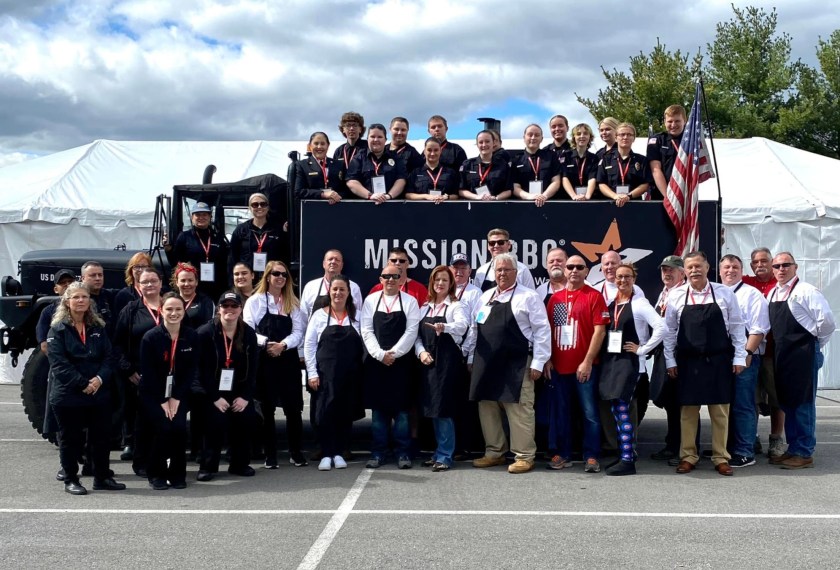
The National Fallen Firefighters Memorial, held annually during the first weekend of October in Emmitsburg, Maryland, is a deeply moving event organized by the National Fallen Firefighters Foundation (NFFF). It honors firefighters who died in the line of duty the previous year, bringing together their families, colleagues, and a small army of volunteers—about a thousand strong—to recognize their sacrifice and provide healing support. Learn more about the NFFF and Memorial Weekend here at (https://www.firehero.org/) This year, I was part of a 20-person food service team tasked with feeding over 800 family members, volunteers, and attendees during two major meal services. The team consists of fire service personnel from all ranks. Chiefs of large urban departments and small shore communities. Retired company officers, as well as rank-file firefighters. Each meal required us to serve hundreds of people in about an hour, with most arriving in the first 30 minutes. To accomplish this, we partnered with two incredible groups: Mission Barbeque, whose employees volunteered their time and expertise, and high school firefighter cadets, who brought energy and dedication to the effort. Both groups were instrumental in our success, and they’ll be featured in future stories.
The Operation: Food Service as Incident Command
Our food service operation was a well-orchestrated effort that mirrored the Incident Command System (ICS). We were the “Food Branch,” led by a director who oversaw two divisions (Tent A and Tent B), a food preparation group (Mission Barbeque and what an amazing group they are. They get their own article in the future), and a support staff (the cadets). Each division had two teams, each led by a division supervisor. The span of control? Four. Coordination? Flawless.
Before each meal, we held detailed briefings to ensure no detail was overlooked. This wasn’t just about serving food—it was about providing comfort, dignity, and care to grieving families. Every detail mattered: from adjusting tent flaps to regulate temperature, to accommodating special dietary needs, to ensuring tables were cleaned and reset quickly for the next group. We even unofficially adopted Crew Resource Management (CRM) principles, encouraging open communication, shared situational awareness, and empowered decision-making.
Our tactical objectives were clear: seat families efficiently, serve meals with compassion, and maintain a seamless flow. At times, two servers teamed up to handle larger groups, while one person in each tent focused on cleaning and resetting tables. The result? Over 400 people served per tent—each seating 210—with minimal errors and maximum care. Our mission, as outlined in the Incident Action Plan, was simple yet profound: Take care of the families. Provide comfort and compassion.
After each meal, we conducted an After Action Review (AAR) using the NFFF’s model:
What was our mission?
What went well?
What could have gone better?
What might we have done differently?
Who needs to know?
This process ensured continuous improvement and reinforced our commitment to excellence. Learn more about the AAR model here (National Fallen Firefighters Foundation, n.d.).
Leadership Lessons Learned
As Bob Dylan once sang, “You Gotta Serve Somebody.” This event was a masterclass in servant leadership. Our team consisted of 20 individuals with over 400 cumulative years of leadership experience, including retired fire chiefs, battalion chiefs, senior state officials, and even a professional baseball player. Yet, we all wore the same uniform: black aprons and white shirts. No badges, no brass, no egos. Our rank was equal, and our mission was singular.
1. Humility and Mission Focus
Keeping our egos in check wasn’t always easy, but it was essential. There were moments when differing opinions arose, but we always returned to the mission: serving the families of fallen heroes. This shared purpose kept us grounded and united. It was a powerful reminder that true leadership isn’t about titles—it’s about serving others with humility and dedication.
2. Synergistic Teamwork
When the going gets tough, the tough get motivated through teamwork. Feeding hundreds of people in a short time required the same intensity and focus as battling a structure fire. We leaned on each other’s energy, collaborated seamlessly, and stepped up to new tasks without hesitation. Serving food wasn’t beneath us—it was humbling and gratifying. As leaders, we learned that no task is too small when it serves a greater purpose.
3. Respect for All Partners
Our success wouldn’t have been possible without Mission Barbeque and the high school cadets. These groups worked tirelessly alongside us, earning our deepest respect and admiration. They reminded us that every team member, regardless of their role or status, contributes to the mission. True leadership means valuing and empowering everyone on the team.
A Light in Unexpected Places
After 14 Memorial Weekends, I didn’t expect to find new inspiration. But this year, working alongside such an incredible team and witnessing the resilience of the families we served, I was reminded of why we do what we do. As Robert Hunter’s lyrics say, “Once in a while, you get shown the light in the strangest of places if you look at it right.” For me, that light came from serving meals to the families of fallen firefighters.
Leadership lessons come in all forms, often when we least expect them. This experience reinforced that being a leader isn’t about commanding others—it’s about serving with compassion, humility, and a commitment to the mission. Whether you’re feeding families or fighting fires, these principles hold true. And sometimes, the most profound lessons come from the simplest acts of service.
References
Bigley, G. A., & Roberts, K. H. (2001). The incident command system: High-reliability organizing for complex and volatile task environments. Academy of Management Journal, 44(6), 1281-1299.
Federal Aviation Administration. (n.d.). Crew Resource Management. Retrieved from https://www.faa.gov
Federal Emergency Management Agency. (n.d.). Incident Command System Resources. Retrieved from https://www.fema.gov
Greenleaf, R. K. (1977). Servant Leadership: A Journey into the Nature of Legitimate Power and Greatness. Paulist Press.
Katzenbach, J. R., & Smith, D. K. (1993). The Wisdom of Teams: Creating the High-Performance Organization. Harvard Business Review Press.
National Fallen Firefighters Foundation. (n.d.). National Fallen Firefighters Memorial Weekend. Retrieved from https://www.firehero.org/
National Fallen Firefighters Foundation. (n.d.). After Action Review (AAR). Retrieved from https://www.everyonegoeshome.com/16-initiatives/13-psychological-support/action-review/
Salas, E., Cooke, N. J., & Rosen, M. A. (2008). On teams, teamwork, and team performance: Discoveries and developments. Human Factors, 50(3), 540-547.
Spears, L. C. (2010). Character and servant leadership: Ten characteristics of effective, caring leaders. The Journal of Virtues & Leadership, 1(1), 25-30.
 TonyECorreia
Great read and important leadership narrative.